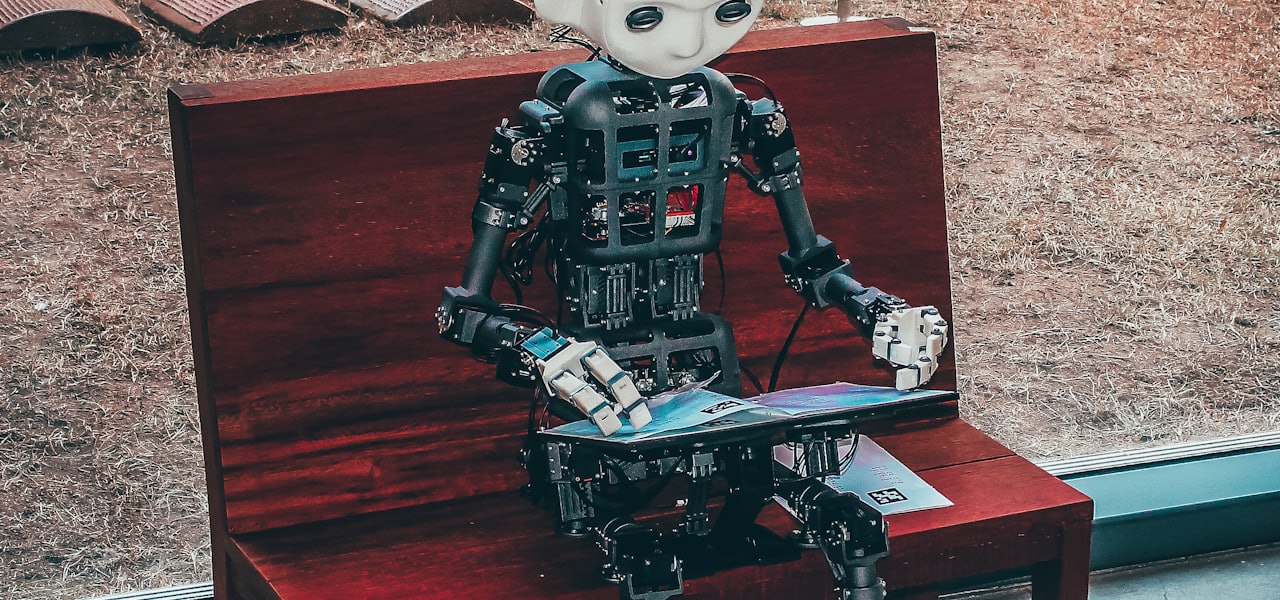
AI For Business Data Analysis

AI For Business Data Analysis — independent reviews, comparisons, pricing and step-by-step guides on Aizhi.

  • Flat-field correction

    Flat-field correction

    Flat-field correction (FFC) is a digital imaging technique to mitigate pixel-to-pixel differences in the photodetector sensitivity and distortions in the optical path. It is a standard calibration procedure in everything from personal digital cameras to large telescopes. == Overview == Flat fielding refers to the process of compensating for different gains and dark currents in a detector. Once a detector has been appropriately flat-fielded, a uniform signal will create a uniform output (hence flat-field). This then means any further signal is due to the phenomenon being detected and not a systematic error. A flat-field image is acquired by imaging a uniformly-illuminated screen, thus producing an image of uniform color and brightness across the frame. For handheld cameras, the screen could be a piece of paper at arm's length, but a telescope will frequently image a clear patch of sky at twilight, when the illumination is uniform and there are few, if any, stars visible. Once the images are acquired, processing can begin. A flat-field consists of two numbers for each pixel, the pixel's gain and its dark current (or dark frame). The pixel's gain is how the amount of signal given by the detector varies as a function of the amount of light (or equivalent). The gain is almost always a linear variable, as such the gain is given simply as the ratio of the input and output signals. The dark-current is the amount of signal given out by the detector when there is no incident light (hence dark frame). In many detectors this can also be a function of time, for example in astronomical telescopes it is common to take a dark-frame of the same time as the planned light exposure. The gain and dark-frame for optical systems can also be established by using a series of neutral density filters to give input/output signal information and applying a least squares fit to obtain the values for the dark current and gain. C = ( R − D ) × m ( F − D ) = ( R − D ) × G {\displaystyle C={\frac {(R-D)\times m}{(F-D)}}=(R-D)\times G} where: C = corrected image R = raw image F = flat field image D = dark frame image m = image-averaged value of (F−D) G = Gain = m ( F − D ) {\displaystyle m \over (F-D)} In this equation, capital letters are 2D matrices, and lowercase letters are scalars. All matrix operations are performed element-by-element. In order for an astrophotographer to capture a light frame, they must place a light source over the imaging instrument's objective lens such that the light source emanates evenly through the users optics. The photographer must then adjust the exposure of their imaging device (charge-coupled device (CCD) or digital single-lens reflex camera (DSLR) ) so that when the histogram of the image is viewed, a peak reaching about 40–70% of the dynamic range (maximum range of pixel values) of the imaging device is seen. The photographer typically takes 15–20 light frames and performs median stacking. Once the desired light frames are acquired, the objective lens is covered so that no light is allowed in, then 15–20 dark frames are taken, each of equal exposure time as a light frame. These are called Dark-Flat frames. == In X-ray imaging == In X-ray imaging, the acquired projection images generally suffer from fixed-pattern noise, which is one of the limiting factors of image quality. It may stem from beam inhomogeneity, gain variations of the detector response due to inhomogeneities in the photon conversion yield, losses in charge transport, charge trapping, or variations in the performance of the readout. Also, the scintillator screen may accumulate dust and/or scratches on its surface, resulting in systematic patterns in every acquired X-ray projection image. In X-ray computed tomography (CT), fixed-pattern noise is known to significantly degrade the achievable spatial resolution and generally leads to ring or band artifacts in the reconstructed images. Fixed pattern noise can be easily removed using flat field correction. In conventional flat field correction, projection images without sample are acquired with and without the X-ray beam turned on, which are referred to as flat fields (F) and dark fields (D). Based on the acquired flat and dark fields, the measured projection images (P) with sample are then normalized to new images (N) according to: N = ( P − D ) ( F − D ) {\displaystyle N={\frac {(P-D)}{(F-D)}}} == Dynamic flat field correction == While conventional flat field correction is an elegant and easy procedure that largely reduces fixed-pattern noise, it heavily relies on the stationarity of the X-ray beam, scintillator response and CCD sensitivity. In practice, however, this assumption is only approximately met. Indeed, detector elements are characterized by intensity dependent, nonlinear response functions and the incident beam often shows time dependent non-uniformities, which render conventional FFC inadequate. In synchrotron X-ray tomography, many factors may cause flat field variations: instability of the bending magnets of the synchrotron, temperature variations due to the water cooling in mirrors and the monochromator, or vibrations of the scintillator and other beamline components. The latter is responsible for the biggest variations in the flat fields. To deal with such variations, a dynamic flat field correction procedure can be employed that estimates a flat field for each individual projection. Through principal component analysis of a set of flat fields, which are acquired prior and/or posterior to the actual scan, eigen flat fields can be computed. A linear combination of the most important eigen flat fields can then be used to individually normalize each X-ray projection: N j = P j − D ¯ F ¯ + ∑ k w j k u k − D ¯ {\displaystyle N_{j}={\frac {P_{j}-{\bar {D}}}{{\bar {F}}+\sum _{k}w_{jk}u_{k}-{\bar {D}}}}} where N j {\displaystyle N_{j}} = intensity normalized X-ray projection P j {\displaystyle P_{j}} = raw X-ray projection F ¯ {\displaystyle {\bar {F}}} = mean flat field image (average of flat fields) u k {\displaystyle u_{k}} = k-th eigen flat field w j k {\displaystyle w_{jk}} = weight of the eigen flat field u k {\displaystyle u_{k}} D ¯ {\displaystyle {\bar {D}}} = mean dark field (average of dark fields)

    Read more →
  • Neuroshima

    Neuroshima

    Neuroshima is a Polish tabletop roleplaying system inspired by such films and games as Mad Max, Fallout, The Matrix, Terminator and Deadlands: Hell on Earth. It is currently available only in Polish. The game's motto is "never trust the machines". Its designers include Michal Oracz and Ignacy Trzewiczek. == Setting == The game describes the United States in the mid-21st century, after a nuclear war started by a cybernetic revolt, which molded the continent into a barren wasteland. It seems that the reason for the war to break out was a sentient Artificial Intelligence commonly referred to as Moloch and made up of interconnected net of military computers: automated factories, military facilities, power plants and alike, that now cover the whole north of the U.S., from Oregon to the Great Lakes. On the south, there is another creation, called the Neojungle, that poses a threat to those who survived the war. It is a semi-intelligent carnivorous vegetation that grows very quickly, advancing north from Latin America. Right in the middle, there are humans. They are surrounded by mutant creatures, some bred by Moloch and hostile towards humans, and some simply animals and humans misshapen by nuclear fallout. On top of that there are Moloch's deadly machines lurking to complete the picture. But what is stressed in the book is that the worst enemy of humans is within them: hatred, indifference, greed. === Landscapes of Neuroshima === Car wrecks, ruined towns and villages, collapsed roofs on deserted houses, broken glass in the windows of abandoned gas stations fill the landscape of the United States of the middle of the 21st century. Technology is history - cars will not start, radios are jammed, no electricity whatsoever almost everywhere the characters go. Shops and malls are looted, prosperous villages are burned by gangers, and safe places are very sparse. === People in Neuroshima === No one knows how many people survived the war with machines, but it is estimated that their number oscillates around 2-3 million. Some people reverted to nomadic lifestyles and live in the deserts, some of them try to build the civilisation anew in devastated cities, some of them form gangs of highwaymen (called gangers), some of them just try to make a living by growing crops, and finally, there are those who just wander around the wasteland; the adventuring sort here is mostly represented by player characters. Each village they visit in this world is a discrete microcosm and nothing is certain as whether the inhabitants are welcoming or shoot strangers on sight. The continent is full of small, anonymous settlements, but there are places which aspire to become post-nuclear states. === Places in Neuroshima === In this world it is very important where you come from, and that is because people are prejudiced and afraid of strangers. Different places produce different kinds of people, and who you are is determined by where you are from. Examples: The Southern Hegemony - (commonly referred to as 'the Hegemony') - located in what was once Arizona, New Mexico and partially Texas. A place where brute force determines one's place in the society. Dominated by gangs and unhampered by Moloch, the Hegemony is a threat to neighbouring lands. Vegas - the only well-lit city in the post-apocalyptic world. Home to many playhouses and casinos, it attracts people from every part of the country. Mother Desert - if you were born in the desert, whenever you go away from civilisation, you feel at home. Many Native Americans still live out there and are doing fine - after all the warheads did not hit the deserts. Detroit - known for some of the best drivers and racers in the post-nuclear US. Home of many gangs, such as The Shultz (mafia styled), Hurons (punkers), The League (racers), Parker Lots (gothic assassins) and the Gas Drinkers (mutant barbarians). New York - a place which has established a strong government and would like to rebuild America. They maintain schools, factories and railways and send soldiers to fight Moloch. Surprisingly enough, they sometimes succeed. Texas - the healthiest place in America. Actually, the only place where one can find green vegetation. Modern Texans still grow crops, breed horses and herd cattle, like their ancestors in the 19th century did. The Appalachian Federation - a place ruled by feudal lords. They have a social class system, in which people are divided into nobility and peasantry. Thanks to its iron and coal deposits, it's one of the richest places in the post-nuclear U.S. The Outpost - A mobile settlement run by scientists who aim to destroy Moloch. In coalition with New York, they manage an army, which is yet to stop Moloch's advance south. They steal technology from the machines they destroy and apply it to their own advantage. == System == The game uses its own, custom system of rules. The dice you use is d20. This system does not have an official name, but it is unconnected to the d20 system, as it typically uses three twenty-sided dice. === Four colours === Neuroshima relies on the division of the gameplay into something the authors called Four Colours, namely steel, chrome, rust and mercury. The choice of a particular colour is made by the gamemaster (the decision can be consulted with the players in order to enhance the game experience) and determines the mood, atmosphere and the type of events/characters present in the story. The name of the colour itself implies the kind of gameplay it will symbolise. These colours are: Steel - this kind of gameplay is characterised by a slightly optimistic attitude towards the world. The aim is to raise the spirit of the characters by showing them that the war with the machines that is going on may be a difficult one, but it is not unwinnable, and that humans, when strong and united, can build the world anew. Example of a story: a unit of soldiers dispatched from the Outpost is sent to build a bunker and establish a relay base far in the north in order to plan a counter-tactic against Moloch's advance south. Chromium - is characterised by a hedonistic attitude. The characters are supposed to enjoy anything that is left from the world after the war and the story is supposed to allow them to do that. Example: the characters are offered a well-paid job by a local ganger boss who extorts wares from local tradesmen. Their job is to drive around the county and pick up the extorted items and trade it for drugs. Rust - a depressing, pessimistic mood. The characters will encounter rust, dilapidation and ruin everywhere they go. All the elements and NPCs of a story played in this mood are supposed to put the characters down and destroy their spirit. Example: the characters, badly wounded after a gunfight and robbed of all their possession find refuge in a village which is constantly raided by gangers. The characters' quest is to repel those attacks, but the enemies outnumber them and are well equipped, whereas the characters have nothing to fight with. Mercury (Quicksilver) - the most depressing side of the game; usually stories played in this mood end with the death of all the characters. The aim of this mood is to show that any kind of action undertaken is futile and that the war is already over, hence all the people are already dead, which is a fact they just need to realise. Example: a group of soldiers stationed in a bunker is awaiting an attack by mutants. They are well-armed and trained, but there is a mistake in the intelligence they were given and they do not know yet that they are seriously outnumbered. The attack commences at dusk and it is already too late to retreat, so the characters decide to seal off the bunker, hopeful that the mutants will not be able to get inside and simply go away. The mutants attack the bunker with chemical weapons instead. The characters do not have enough gas masks to go around. As an effect, those strong enough will kill the weaker ones to get their masks, not knowing that the mutants will blow up the sealed entrance the following morning. == Official rulebooks and sourcebooks == The current edition is 1.5 [1]. Since the release of the game in 2003, sourcebooks have been appearing. The game keeps growing bigger with every add-on, as well as the storyline, which is updated in those sourcebooks and in Space Pirate (pl. Gwiezdny Pirat) magazine, also published by Portal. === List of released rulebooks and sourcebooks === Neuroshima 1.0 - the original edition of the core rulebook (out of print). Neuroshima 1.5 - enhanced and revised core rulebook, with new material added and some material cut out. Wyścig (The Race) - sourcebook dedicated to cars and racing; contains rules concerning building your own vehicle and new character classes connected with driving. Gladiator - sourcebook describing in detail the "Gladiator" character class. Supplement (Supplement) - sourcebook revising the core rulebook. Detroit - sourcebook describing the city of Detroit, its inhabi

    Read more →
  • Hindsight optimization

    Hindsight optimization

    Hindsight optimisation (HOP) is a computer science technique used in artificial intelligence for analysis of actions which have stochastic results. HOP is used in combination with a deterministic planner. By creating sample results for each of the possible actions from the given state (i.e. determinising the actions), and using the deterministic planner to analyse those sample results, HOP allows an estimate of the actual action.

    Read more →
  • AI@50

    AI@50

    AI@50, formally known as the "Dartmouth Artificial Intelligence Conference: The Next Fifty Years" (July 13–15, 2006), was a conference organized by James H. Moor, commemorating the 50th anniversary of the Dartmouth workshop which effectively inaugurated the history of artificial intelligence. Five of the original ten attendees were present: Marvin Minsky, Ray Solomonoff, Oliver Selfridge, Trenchard More, and John McCarthy. While sponsored by Dartmouth College, General Electric, and the Frederick Whittemore Foundation, a $200,000 grant from the Defense Advanced Research Projects Agency (DARPA) called for a report of the proceedings that would: Analyze progress on AI's original challenges during the first 50 years, and assess whether the challenges were "easier" or "harder" than originally thought and why Document what the AI@50 participants believe are the major research and development challenges facing this field over the next 50 years, and identify what breakthroughs will be needed to meet those challenges Relate those challenges and breakthroughs against developments and trends in other areas such as control theory, signal processing, information theory, statistics, and optimization theory. A summary report by the conference director, James H. Moor, was published in AI Magazine. == Conference Program and links to published papers == James H. Moor, conference Director, Introduction Carol Folt and Barry Scherr, Welcome Carey Heckman, Tonypandy and the Origins of Science === AI: Past, Present, Future === John McCarthy, What Was Expected, What We Did, and AI Today Marvin Minsky, The Emotion Machine === The Future Model of Thinking === Ron Brachman and Hector Levesque, A Large Part of Human Thought David Mumford, What is the Right Model for 'Thought'? Stuart Russell, The Approach of Modern AI === The Future of Network Models === Geoffrey Hinton & Simon Osindero, From Pandemonium to Graphical Models and Back Again Rick Granger, From Brain Circuits to Mind Manufacture === The Future of Learning & Search === Oliver Selfridge, Learning and Education for Software: New Approaches in Machine Learning Ray Solomonoff, Machine Learning — Past and Future Leslie Pack Kaelbling, Learning to be Intelligent Peter Norvig, Web Search as a Product of and Catalyst for AI === The Future of AI === Rod Brooks, Intelligence and Bodies Nils Nilsson, Routes to the Summit Eric Horvitz, In Pursuit of Artificial Intelligence: Reflections on Challenges and Trajectories === The Future of Vision === Eric Grimson, Intelligent Medical Image Analysis: Computer Assisted Surgery and Disease Monitoring Takeo Kanade, Artificial Intelligence Vision: Progress and Non-Progress Terry Sejnowski, A Critique of Pure Vision === The Future of Reasoning === Alan Bundy, Constructing, Selecting and Repairing Representations of Knowledge Edwina Rissland, The Exquisite Centrality of Examples Bart Selman, The Challenge and Promise of Automated Reasoning === The Future of Language and Cognition === Trenchard More The Birth of Array Theory and Nial Eugene Charniak, Why Natural Language Processing is Now Statistical Natural Language Processing Pat Langley, Intelligent Behavior in Humans and Machines === The Future of the Future === Ray Kurzweil, Why We Can Be Confident of Turing Test Capability Within a Quarter Century George Cybenko, The Future Trajectory of AI Charles J. Holland, DARPA's Perspective === AI and Games === Jonathan Schaeffer, Games as a Test-bed for Artificial Intelligence Research Danny Kopec, Chess and AI Shay Bushinsky, Principle Positions in Deep Junior's Development === Future Interactions with Intelligent Machines === Daniela Rus, Making Bodies Smart Sherry Turkle, From Building Intelligences to Nurturing Sensibilities === Selected Submitted Papers: Future Strategies for AI === J. Storrs Hall, Self-improving AI: An Analysis Selmer Bringsjord, The Logicist Manifesto Vincent C. Müller, Is There a Future for AI Without Representation? Kristinn R. Thórisson, Integrated A.I. Systems === Selected Submitted Papers: Future Possibilities for AI === Eric Steinhart, Survival as a Digital Ghost Colin T. A. Schmidt, Did You Leave That 'Contraption' Alone With Your Little Sister? Michael Anderson & Susan Leigh Anderson, The Status of Machine Ethics Marcello Guarini, Computation, Coherence, and Ethical Reasoning

    Read more →
  • Language-Theoretic Security

    Language-Theoretic Security

    Language-theoretic security, or LangSec, is an approach to software security that focuses on input handling, complexity, and program design as strategies to improve the verifiability of computer programs. It was introduced in 2005 by Robert J. Hansen and Meredith L. Patterson at BlackHat and in 2011 by Len Sassaman and Patterson. It aims to create a formal description of which software is likely to have security vulnerabilities of particular classes, and why. It considers programs to have an inherent parser component, whether or not explicit, composed of that part of the program which operates on external input before that input is fully parsed. A central hypothesis of language-theoretic security is that vulnerabilities in software increase according to the computational power of the notional input-accepting automaton equivalent to this parser, using the definitions of automata theory. The lower bound on this computational power is the input language complexity of the program. The extent to which reducing this complexity is possible is a function of the specification of the communication protocol or file format the program takes as input. == Parsing as a security mechanism == The behaviour of a program is defined with reference to its expected input. Unexpected input being used by a program is a factor in numerous security bugs, including the so-called Android master key vulnerability (CVE-2013-4787), because accepting unexpected input renders the program's specification ambiguous. In that instance, the unexpected ambiguity came in the form of a ZIP file with duplicate filenames. If a program fully parses its input and only acts on input that unambiguously meets the specification, it follows that the program will avoid these types of vulnerabilities. This is an intentional inversion of the Postel principle. Accepting only unambiguous and valid input is a more formal requirement than input validation or sanitization, and narrows the number of possible but unanticipated program states that can be induced in an application via user input. Conversely, failure to do this is associated with security vulnerabilities. Input sanitization in particular is held to be an inadequate approach to avoiding malicious input because it inherently ignores context-sensitive properties of the input; it can therefore result in paradoxical effects, such as sanitization code activating otherwise inert cross-site scripting payloads in browsers. === Parser differentials === If the language of accepted program input is sufficiently simple, it is possible to verify that two implementations parse the same input language consistently. This is advantageous because it shows no parser differential exists between the two implementations. The requisite level of simplicity is theoretically that for which there is a solution to the equivalence problem. If the two parsers involved in CVE-2013-4787 were equivalent - that is, if they rendered the same output state given the same input state - the vulnerability could not have existed. One strategy for doing this is to publish machine-readable specifications of a format or protocol, and then use a parser generator to generate the parser code. An example of a parser generator built for this purpose is DaeDaLus. The combination of Lex with any of GNU Bison, ANTLR, or Yacc also accomplishes this. However, many parser generators allow the mixing of general purpose code with the parsing definitions, which weakens the guarantees provided by parsing. === Analysis of injection attacks === Injection attacks are generally the result of differences between the serializer (or "unparser") and the corresponding parser at a layer boundary in a system; therefore, they are a special case of parser differentials. In a SQL injection attack, for example, an attacker is able to cause the application with which they are interacting to serialize a SQL query that has different semantics than intended. In the simplest case where the payload ends a string and adds new code, the payload has crossed the code-data boundary in SQL. In language-theoretic security, this is treated as a bug in the serializer of the SQL query, which should instead be written in a way that constrains its possible outputs to those within the scope of the intended query. === Parser combinators === If a parser generator is not used, it is still possible to avoid implementation bugs by using parser combinator such as Nom to implement the parser code. This has the drawback of relying on a programmer correctly translating the specification into the language of the parser generator library, though this task is still less error-prone than hand-coding a parser. == Input format complexity == Complexity in computer programs is associated with security vulnerabilities. Within the domain of language-theoretic security, complexity is described with reference to the computational power of the abstract machine necessary to implement the program, or more particularly, to implement the parser for its input language. This complexity describes whether it is possible to show that there is no unintended or undesired functionality in the program which might be exploitable by an attacker. To be bounded in complexity, the program's input must be well-defined both in terms of form and of semantics. === Weird machines === A weird machine is a model of computation in a program that exists in parallel with, but is distinct from, the intended abstract model of computation in that program. Some classes of weird machine arise from the multi-layered nature of computer programs, or the context in which the programs run; others result from the unanticipated functionality a program has due to its complexity or to software bugs. The more complex the computation model of a program, the more likely it is to implement a weird machine. Depending on context, the weird machine may or may not be concretely useful for an attacker. Since the space of weird machines in the context of some program is the universe of all possible states that are not within the program's intended states, many exploited states including remote code execution and injection attacks belong to the domain of weird machines. A reduction in weird machines is therefore a likely correlate with reduced program vulnerability. === SafeDocs project === SafeDocs is a DARPA project undertaken in 2018 to take existing file formats, create safer subsets of them, and develop programming tools to work for the safer formats. The initial test case for this was PDF. The purpose of creating safer subsets in this case is to lower the minimum bound on parser complexity so that it becomes possible to create tools that will generate correct, normative parsers for them. == Relation to programming languages == The analytic framework of language-theoretic security assumes programs to be virtual machines that execute their input. A document that is read by an application is in this sense a form of machine code, in a generalization of the data as code idea, following the automata theory description of parsers. === Type-safe programming languages === Parsing input and serializing output are operations that consume one data type and emit another. A programming language can therefore check that data is correctly parsed and contains the expected structure by checking data types, and correct serializing (or unparsing) can be implemented as operations on the data types that are relevant to the program's output. This approach can be used to show that the recognizer and unparser patterns have been implemented. It is also possible to implement type checking across a distributed system to enforce parsing and unparsing of the expected structures and to verify that the assumptions made in designing the compositional properties of a distributed system have been followed. === Memory-safe programming languages === In the general case, spatial memory correctness is undecidable. If any proof of spatial memory correctness is to be made, it is therefore necessary to bound the complexity of the code. Interpreted languages such as Java and Python effectively accomplish this via runtime bounds checking, and frameworks for runtime bounds checking also exist for C. The effect of these strategies for spatial memory correctness are to create a halt state in place of a spatial memory correctness violation; therefore, it can be shown that the program will not violate spatial memory correctness, but in exchange, it cannot be shown in the general case that programs will not have runtime bounds checking exceptions. Some programming languages, such as Rust, accomplish this using borrow checking. The borrow checker acts to assure spatial memory correctness by compile-time reference counting. Code for which spatial memory correctness cannot be shown to not be violated therefore does not compile, inherently limiting the complexity of the spatial memory correctness of the program to what is decidable. Thi

    Read more →
  • Argumentation theory

    Argumentation theory

    Argumentation theory is the interdisciplinary study of how conclusions can be supported or undermined by premises through logical reasoning. With historical origins in logic, dialectic, and rhetoric, argumentation theory includes the arts and sciences of civil debate, dialogue, conversation, and persuasion. It studies rules of inference, logic, and procedural rules in both artificial and real-world settings. Argumentation includes various forms of dialogue such as deliberation and negotiation which are concerned with collaborative decision-making procedures. It also encompasses eristic dialogue, the branch of social debate in which victory over an opponent is the primary goal, and didactic dialogue used for teaching. This discipline also studies the means by which people can express and rationally resolve or at least manage their disagreements. Argumentation is a daily occurrence, such as in public debate, science, and law. For example in law, in courts by the judge, the parties and the prosecutor, in presenting and testing the validity of evidences. Also, argumentation scholars study the post hoc rationalizations by which organizational actors try to justify decisions they have made irrationally. Argumentation is one of four rhetorical modes (also known as modes of discourse), along with exposition, description, and narration. == Key components of argumentation == Some key components of argumentation are: Understanding and identifying arguments, either explicit or implied, and the goals of the participants in the different types of dialogue. Identifying the premises from which conclusions are derived. Establishing the "burden of proof" – determining who made the initial claim and is thus responsible for providing evidence why their position merits acceptance. For the one carrying the "burden of proof", the advocate, to marshal evidence for their position in order to convince or force the opponent's acceptance. The method by which this is accomplished is producing valid, sound, and cogent arguments, devoid of weaknesses, and not easily attacked. In a debate, fulfillment of the burden of proof creates a burden of rejoinder. One must try to identify faulty reasoning in the opponent's argument, to attack the reasons/premises of the argument, to provide counterexamples if possible, to identify any fallacies, and to show why a valid conclusion cannot be derived from the reasons provided for their argument. For example, consider the following exchange, illustrating the No true Scotsman fallacy: Argument: "No Scotsman puts sugar on his porridge." Reply: "But my friend Angus, who is a Scotsman, likes sugar with his porridge." Rebuttal: "Well perhaps, but no true Scotsman puts sugar on his porridge." In this dialogue, the proposer first offers a premise, the premise is challenged by the interlocutor, and so the proposer offers a modification of the premise, which is designed only to evade the challenge provided. == Internal structure of arguments == Typically an argument has an internal structure, comprising the following: a set of assumptions or premises, a method of reasoning or deduction, and a conclusion or point. An argument has one or more premises and one conclusion. Often classical logic is used as the method of reasoning so that the conclusion follows logically from the assumptions or support. One challenge is that if the set of assumptions is inconsistent then anything can follow logically from inconsistency. Therefore, it is common to insist that the set of assumptions be consistent. It is also good practice to require the set of assumptions to be the minimal set, with respect to set inclusion, necessary to infer the consequent. Such arguments are called MINCON arguments, short for minimal consistent. Such argumentation has been applied to the fields of law and medicine. A non-classical approach to argumentation investigates abstract arguments, where 'argument' is considered a primitive term, so no internal structure of arguments is taken into account. == Types of dialogue == In its most common form, argumentation involves an individual and an interlocutor or opponent engaged in dialogue, each contending differing positions and trying to persuade each other, but there are various types of dialogue: Persuasion dialogue aims to resolve conflicting points of view of different positions. Negotiation aims to resolve conflicts of interests by cooperation and dealmaking. Inquiry aims to resolve general ignorance by the growth of knowledge. Deliberation aims to resolve a need to take action by reaching a decision. Information seeking aims to reduce one party's ignorance by requesting information from another party that is in a position to know something. Eristic aims to resolve a situation of antagonism through verbal fighting. == Argumentation and the grounds of knowledge == Argumentation theory had its origins in foundationalism, a theory of knowledge (epistemology) in the field of philosophy. It sought to find the grounds for claims in the forms (logic) and materials (factual laws) of a universal system of knowledge. The dialectical method was made famous by Plato and his use of Socrates critically questioning various characters and historical figures. But argument scholars gradually rejected Aristotle's systematic philosophy and the idealism in Plato and Kant. They questioned and ultimately discarded the idea that argument premises take their soundness from formal philosophical systems. The field thus broadened. One of the original contributors to this trend was the philosopher Chaïm Perelman, who together with Lucie Olbrechts-Tyteca introduced the French term la nouvelle rhetorique in 1958 to describe an approach to argument which is not reduced to application of formal rules of inference. Perelman's view of argumentation is much closer to a juridical one, in which rules for presenting evidence and rebuttals play an important role. Karl R. Wallace's seminal essay, "The Substance of Rhetoric: Good Reasons" in the Quarterly Journal of Speech (1963) 44, led many scholars to study "marketplace argumentation" – the ordinary arguments of ordinary people. The seminal essay on marketplace argumentation is Ray Lynn Anderson's and C. David Mortensen's "Logic and Marketplace Argumentation" Quarterly Journal of Speech 53 (1967): 143–150. This line of thinking led to a natural alliance with late developments in the sociology of knowledge. Some scholars drew connections with recent developments in philosophy, namely the pragmatism of John Dewey and Richard Rorty. Rorty has called this shift in emphasis "the linguistic turn". In this new hybrid approach argumentation is used with or without empirical evidence to establish convincing conclusions about issues which are moral, scientific, epistemic, or of a nature in which science alone cannot answer. Out of pragmatism and many intellectual developments in the humanities and social sciences, "non-philosophical" argumentation theories grew which located the formal and material grounds of arguments in particular intellectual fields. These theories include informal logic, social epistemology, ethnomethodology, speech acts, the sociology of knowledge, the sociology of science, and social psychology. These new theories are not non-logical or anti-logical. They find logical coherence in most communities of discourse. These theories are thus often labeled "sociological" in that they focus on the social grounds of knowledge. == Kinds of argumentation == === Conversational argumentation === The study of naturally occurring conversation arose from the field of sociolinguistics. It is usually called conversation analysis (CA). Inspired by ethnomethodology, it was developed in the late 1960s and early 1970s principally by the sociologist Harvey Sacks and, among others, his close associates Emanuel Schegloff and Gail Jefferson. Sacks died early in his career, but his work was championed by others in his field, and CA has now become an established force in sociology, anthropology, linguistics, speech-communication and psychology. It is particularly influential in interactional sociolinguistics, discourse analysis and discursive psychology, as well as being a coherent discipline in its own right. Recently CA techniques of sequential analysis have been employed by phoneticians to explore the fine phonetic details of speech. Empirical studies and theoretical formulations by Sally Jackson and Scott Jacobs, and several generations of their students, have described argumentation as a form of managing conversational disagreement within communication contexts and systems that naturally prefer agreement. === Mathematical argumentation === The basis of mathematical truth has been the subject of long debate. Frege in particular sought to demonstrate (see Gottlob Frege, The Foundations of Arithmetic, 1884, and Begriffsschrift, 1879) that arithmetical truths can be derived from purely logical axioms and therefore are, in th

    Read more →
  • Clanker

    Clanker

    Clanker is a derogatory term for robots and artificial intelligence (AI) software. The term has been used in Star Wars media, first appearing in the franchise's 2005 video game Star Wars: Republic Commando. In 2025, the term became widely used to express hatred or distaste for machines ranging from delivery robots to large language models. This trend has been attributed to anxiety around the negative societal effects of AI. == In science fiction == The term has been previously used in science fiction literature, first appearing in a 1958 article by William Tenn in which he uses it to describe robots from science fiction films like Metropolis. The Star Wars franchise began using the term as a slur against droids in the 2005 video game Star Wars: Republic Commando before being prominently used in the animated series Star Wars: The Clone Wars, which follows a galaxy-wide war between the Galactic Republic's clone troopers and the Confederacy of Independent Systems' battle droids. In Star Wars media, robots—more commonly known as droids—are routinely depicted as the subjects of discrimination. For example, in the original Star Wars film, C-3PO and R2-D2 are abducted by Jawas and sold to the family of Luke Skywalker. When visiting a cantina in Mos Eisley, both droids are refused service by the bartender, who remarks that "We don't serve their kind." In Star Wars lore, the term clanker had entered use by the time of the franchise's High Republic Era and became prominent during the Clone Wars, in which clone troopers regularly use the phrase against battle droids. == AI backlash == The growing popularity of the term clanker reflects an increase in direct contact between people and AI systems. On sidewalks, delivery robots impede mobility and cause safety issues. In digital spaces, cybersecurity experts have raised concerns about the rising number of bots online, which now make up a large portion of internet traffic. A 2025 report estimated that about one in five social media accounts are automated. The term is also a reaction to AI advocacy from industrialists like Elon Musk and Sam Altman, who have championed the integration of AI into nearly every aspect of modern life. This includes efforts by major companies and startups alike, such as Amazon's development of humanoid robots to replace human workers in service industries. Such initiatives have further fueled public skepticism, reinforcing the association of clanker with unease over automation and the displacement of human roles. A global survey conducted by the research firm Gartner in December 2023 found that 64% of customers would prefer companies to avoid using AI in customer service, with another 53% stating they would consider switching to a different company if they discovered AI was handling their service interactions. Another report by Ernst & Young, published in July 2025, found that 42% of employees across Europe are worried that the use of AI in the workplace may threaten their employment. Criticism has also been directed at the technology itself. Some of the backlash stems from concerns about the resource consumption of AI systems, their frequent reliance on copyrighted material without consent, and questions about the intentions of the corporations behind them. There are also concerns about the potential cognitive effects of relying heavily on AI. A study, authored by researchers at Microsoft and Carnegie Mellon University, warns that regular dependence on AI may leave users mentally unprepared for real-world problem solving, likening the effect to cognitive atrophy. In June 2025, United States Senator Ruben Gallego tweeted that his "new bill makes sure you don't have to talk to a clanker if you don't want to", referring to proposed legislation that would require call centers to disclose their use of automated customer service agents to callers in the United States and offer the option to switch to a human representative. == Analysis == Linguist Adam Aleksic has described clanker as an evolution of racial slurs that anthropomorphize robotic systems. Internet memes incorporating the term often reference historical discrimination against marginalized groups such as African Americans. Based on the work of linguist Geoffrey Nunberg, American news website Axios has argued that clanker is merely a derogatory word, rather than a slur, because it does not perpetuate social inequities. NPR has noted the irony that the word robot was coined by Karel Čapek for his 1920 science-fiction play R.U.R. as a similar criticism of industrialization forcing workers to become devoid of their humanity. Aleksic has observed that robot can be further traced to the Proto-Slavic noun orbъ, which means 'slave'. While other science fiction media include pejoratives for androids and robots, such as skinjob and toaster from the Blade Runner and Battlestar Galactica franchises, respectively, clanker is believed to have gained popularity because its usage is intuitive and flexible. Whereas AI slop describes low-quality output from artificial intelligence, clanker belittles the underlying computer systems.

    Read more →
  • Rifts (role-playing game)

    Rifts (role-playing game)

    Rifts is a multi-genre role-playing game created by Kevin Siembieda in August 1990 and published continuously by Palladium Books since then. It takes place in a post-apocalyptic future, deriving elements from cyberpunk, science fiction, fantasy, horror, western, mythology and many other genres. Rifts serves as a cross-over environment for a variety of other Palladium games with different universes connected through "rifts" on Earth that lead to different spaces, times, and realities that Palladium calls the "Rifts Megaverse". Rifts describes itself as an "advanced" role-playing game and not an introduction for those new to the concept. Palladium continues to publish books for the Rifts series, with about 80 books published between 1990 and 2011. Rifts Ultimate Edition was released in August 2005 and designed to update the game with Palladium's incremental changes to its system, changes in the game world, and additional information and character types. The web site is quick to point out that this is not a second edition but an improvement and expansion of the original role playing game. == Background == The RPG had the tentative title Boomers, named after the original name for the Glitter Boy power armor until Kevin Siembieda changed the name after finding out it was in use for Bubblegum Crisis. == Setting == The Rifts world is Earth, but hundreds of years into the future. Ley lines, lines of magic energy, criss-cross the earth forming supernatural geographic areas such as the Bermuda Triangle. Points where Ley Lines intersect, called a nexus, are places of powerful magic, such as the Pyramids of Giza and Stonehenge. If a Ley Line nexus energy surges or is purposely activated, the fabric of space and time can be torn, creating a rift - a hole in space-time leading to another place, time, or dimension. Ley lines contain magical energy called Potential Psychic Energy (PPE), which is found in various places, objects, and animals and is particularly strong in children. An adult's level of PPE can vary based on other factors. PPE also allows Psionics which uses energy known as Inner Strength Points or ISP. Psychic phenomenon (more commonly called psionics) can also vary from individuals, ranging from none at all to Master level abilities. Psychic abilities can manifest in virtually any way imaginable. Some psychics develop differently, such as psi-stalkers; human mutants that feed on psychic energy. === Earth === Rifts begins with two future-historical premises: first, a golden age of humanity occurs, with tremendous advances in science, technology, military, and society. Humanity as a whole is at peace as a majority of Earth's nations decide to cease world war and begin to share ideas and technology freely. Much of the Solar System is conquered, humanity's wars will end, and harmony will reign. This golden age is followed by an unknown cause near the winter solstice and a rare planetary alignment, causing a disaster that cascades into tremendous destruction via a ripple effect. The cataclysm begins with unprecedented storms, earthquakes, tsunamis, and volcanic eruptions, which kill millions of people. The Ley Line networks that crisscross the globe are energized, causing rifts to open both on Earth and throughout the Megaverse. For hundreds of years after the holocaust, many creatures, both mythical beasts and aliens, come through the Rifts to wreak havoc. The old world gone, a new Dark Age dawns and humanity's shrinking population is reduced, due to catastrophe and domestic failure, immeasurably. This period is covered in Palladium's Rifts Chaos Earth spin-off series. Rifts initially takes place in 101 P.A. (equivalent to the year 2387) 289 years after this event. The "Post-Apocalypse" calendar was established by the formation of the Coalition States in 2286. By this time, most of the disasters have quieted down, though Earth is still bathed in PPE. The planet's mystical energy has attracted aliens from other dimensions, who continue to arrive through the Rifts both accidentally and deliberately. The humanoid creatures that arrive on Earth are referred to as Dimensional Beings (called D-Bees). Some resemble familiar fantasy races, such as elves and dwarfs, while others were created specifically for the game setting. Non-humanoid creatures have also arrived, including monstrous creatures and mystical demons. To cope with these natural, supernatural, and alien menaces, the human race has adapted in a variety of ways, many of them borrowed from the technological developments of the lost Golden Age. Powered armor suits and giant vehicles are frequently used to combat the dangers of Rifts, but more invasive augmentation is common. This has three basic categories: "Juicers" augment themselves chemically, the "Borgs" augment themselves mechanically, and "Crazies" use performance-enhancing brain implants. All such augmentations boost strength, speed, endurance, and dexterity to superhuman levels. However, all come at great cost. Chemicals cause the body to wear out faster, decreasing life span to a few years. Mechanical Borg augmentation causes a loss of humanity when those with multiple limb and organ replacements become more machine than human. Brain implants cause mental instability ranging from mild phobias to crippling neurosis or psychosis. ==== North America ==== The strongest power in North America is the Coalition States (CS), which is based in the arcological city of Chi-Town and lays claim to northern Illinois, all of Iowa, the Texas Panhandle, Missouri, and the eastern half of Ontario, Canada. The second greatest power is Free Quebec, a former Coalition State that seceded following a civil war with the other Coalition States. Mexico is ruled by a group of vampire kingdoms, who treat humans as little more than food. North of the Rio Grande, west of Texas and roaming most of the American Southwest are large nomadic bands/tribes of bandits who collectively form the Pecos Empire, consisting of El Paso, Los Alamos, and Houstown. Much of the western United States has more or less willingly reverted to a mix of modern and past technology akin to the Wild West. The Royal Canadian Mounted Police managed to survive the great cataclysm, though Canada itself did not. The Mounties have become an independent law enforcement force called the Tundra Rangers, patrolling the northern wilderness. The Midwest, both upper and central, is home to most of North America's population. The Manistique Imperium and Northern Gun in Michigan's Upper Peninsula, both Coalition allies, are among the largest weapons manufacturing areas on the continent. New Lazlo is one of the largest cities in Michigan's southern portion. Chillicothe in Missouri is a large supplier of Coalition food processing and growing. Missouri's southern half, home to the city-states of Whykin (Poplar Bluff) and Kingsdale (West Plains) are in constant opposition to the CS and claim independence. Arkansas is home to the independent CS ally El Dorado. Southern Illinois and the Ohio Valley is home to the Federation of Magic. Also in the Ohio Valley is Psyscape, a city-state founded by psychics. Tolkeen was a major city in the former Minneapolis region in early Rifts books; the city welcomed users of magic. A military campaign made by the Coalition States (which is the primary event of 109 PA) resulted in the magic-user kingdom being wiped off the map. In the Northeast, the city-state of Lazlo, named after supernatural researcher and writer Victor Lazlo, was built upon the ruins of Toronto. This major center of civilization is well known as a melting pot of humans, D-Bees and other beings, and is the home of Techno-Wizardry. Mad Haven is the name given to the ruins of Manhattan; tectonic forces during the cataclysm have moved it into the coast, creating a peninsula. It is seen by most denizens of Rifts Earth as a refuge of demons and madness. ==== South America ==== The return of Atlantis caused the Amazon River basin to flood most of western South America, giving it the nickname The Land of a Thousand Islands. The Empire of the Sun, consisting of Cuzco, Nazca, Arequipa and Lima, created a wide range of technology and magic, including magic derived from the Nazca lines. In Argentina, the Silver River Republics of Cordoba (the South American Chi-Town), Santiago (one of the most tolerant human nations on Rifts Earth), Achilles (a nation founded by mutants), and New Babylon, a nation where humans and aliens coexist) have thrived and created nations whose strength rivals that of the CS. In Bolivia, freed Human and D-Bees formed the Megaversal Legion: a mercenary company with one of the highest levels of technology on Rifts Earth. ==== Europe ==== England has become a vast wilderness again, broken up by the occasional giant Millennium Tree or feudal kingdom, complete with a New Camelot and a new King Arthur, partially being manipulated by an alien intelligence disguised as Merlin. Also the magic of

    Read more →
  • ChromaDB

    ChromaDB

    Chroma or ChromaDB is open-source data infrastructure tailored to applications with large language models. Its headquarters are in San Francisco. In April 2023, it raised 18 million US dollars as seed funding. ChromaDB has been used in academic studies on artificial intelligence, particularly as part of the tech stack for retrieval-augmented generation.

    Read more →
  • Sugeno integral

    Sugeno integral

    In mathematics, the Sugeno integral, introduced by Michio Sugeno as a fuzzy integral in work on fuzzy measures at the Tokyo Institute of Technology, is a type of integral with respect to a fuzzy measure. Let ( X , Ω ) {\displaystyle (X,\Omega )} be a measurable space and let h : X → [ 0 , 1 ] {\displaystyle h:X\to [0,1]} be an Ω {\displaystyle \Omega } -measurable function. The Sugeno integral over the crisp set A ⊆ X {\displaystyle A\subseteq X} of the function h {\displaystyle h} with respect to the fuzzy measure g {\displaystyle g} is defined by: ∫ A h ( x ) ∘ g = sup E ⊆ X [ min ( min x ∈ E h ( x ) , g ( A ∩ E ) ) ] = sup α ∈ [ 0 , 1 ] [ min ( α , g ( A ∩ F α ) ) ] {\displaystyle \int _{A}h(x)\circ g={\sup _{E\subseteq X}}\left[\min \left(\min _{x\in E}h(x),g(A\cap E)\right)\right]={\sup _{\alpha \in [0,1]}}\left[\min \left(\alpha ,g(A\cap F_{\alpha })\right)\right]} where F α = { x | h ( x ) ≥ α } {\displaystyle F_{\alpha }=\left\{x|h(x)\geq \alpha \right\}} . The Sugeno integral over the fuzzy set A ~ {\displaystyle {\tilde {A}}} of the function h {\displaystyle h} with respect to the fuzzy measure g {\displaystyle g} is defined by: ∫ A h ( x ) ∘ g = ∫ X [ h A ( x ) ∧ h ( x ) ] ∘ g {\displaystyle \int _{A}h(x)\circ g=\int _{X}\left[h_{A}(x)\wedge h(x)\right]\circ g} where h A ( x ) {\displaystyle h_{A}(x)} is the membership function of the fuzzy set A ~ {\displaystyle {\tilde {A}}} . == Usage and Relationships == Sugeno integral is related to h-index.

    Read more →
  • The Way (novel series)

    The Way (novel series)

    The Way series is a trilogy of science fiction novels and one short story by American author Greg Bear published from 1985 to 1999. The first novel was Eon (1985), followed by a sequel, Eternity and a prequel, Legacy. It also includes The Way of All Ghosts, a short story that falls between Legacy and Eon. == Novels == === Eon === Eon chronicles the appearance and discovery of the Thistledown, and its subsequent effect on humanity. In the early 21st century, the United States and the USSR are on the verge of nuclear war. In that tense political climate, an asteroid appears out of near space after an unusual supernova and settles into an extremely elliptical orbit near Earth orbit. The two nations each try to claim this mysterious object, which appears to be a virtual duplicate of Juno. It is hollow and contains seven vast terraformed chambers. Two of the chambers contain cities long abandoned by human beings who seemed to come from Earth's future. The asteroid is called the Thistledown by its builders. A startling discovery is that it is bigger inside than outside. The seventh chamber appears to stretch into infinity. The human inhabitants of the Thistledown come from an alternate timeline, approximately 1000 years in the future. In their timeline, human civilization was nearly destroyed by the "Death", a calamitous World War involving nuclear weapons. The Death occurred at approximately the same time as the appearance of the Thistledown in the present time. Its presence threatens to cause the Death to occur on the current timeline as well. An expedition is sent down the seemingly infinite seventh chamber (The "Way", as it is known) where it encounters the descendants of humanity. The high technology of this civilization, known as the Hexamon, has control over genetic engineering, human augmentation, and matter itself. The Hexamon includes several alien species who have come to live with humanity's descendants. The Hexamon itself is at war with an alien race known as the Jarts from further down the corridor still. In 2007, CGSociety organised a "CG Challenge" based upon Eon === Eternity === Jarts, politics, and technology make up the second book in the series: Eternity. The Jart religion is based on the preservation of all data, which encompasses all life forms, past and present, and sending that data to the Jarts' future masters, their descendants. === Legacy === In the third book (a prequel, set in the time before Eon), Legacy, soldier Olmy ap Sennon is sent to spy on a group of dissidents who have used the spacetime tunnel of "the Way" (introduced in Eon) to colonize the alien world of Lamarckia, a planet with an ecosystem that learns from its changed environment in a way that resembles Lamarckian evolution. Its plants and animals turn out to actually be parts of continent-sized organisms. === "The Way of All Ghosts" === In the short story "The Way of All Ghosts" soldier Olmy ap Sennon is sent to close a lesion that formed out of a wayward gate into perfection. This story was published in 1999 in Far Horizons. == Fictional history of the Thistledown == Within the universe of The Way, the Thistledown is an asteroid starship built by hollowing out Juno and fitting it with mass-driver (rail gun) engines and thermonuclear drives. Inside the asteroid, seven giant "Chambers" are built, of which two host cities for the inhabitants, while others host machinery and recreation areas. The asteroid is prepared 500 years in the future, as told in Bear's novel Eon, and is engaged on a multi-generational journey to Epsilon Eridani, around which a habitable planet is known to circle. The journey is meant to take 60 years, as the ship can only maintain a velocity of 20% the speed of light. This limitation is removed after the technology of the Thistledown was improved to include inertial dampeners, allowing higher accelerations. Inhabiting the Thistledown are the best and brightest of Earth, who are quite diverse both culturally and politically. The Thistledown's society includes one transcendent genius, Konrad Korzenowski, whose preference for living in the Thistledown as compared with an outer universe, causes him to experiment with closed-geodesic space time in the Seventh Chamber, 20 years into the Thistledown's voyage. The results of his experiments are shattering in the extreme: He creates a unique pocket universe: The Way. == The Way == === Origin === The eponymous Way is an extension of the 7th Chamber, and was formed in the novels using the machinery of the 6th Chamber. This machinery is a selective inertial damper, developed by engineers within the Thistledown with twofold purpose—to permit the Thistledown to accelerate to the limit of its engines (up to 99% the speed of light) and to selectively dampen inertia within the vessel, e.g., water within waterways, high velocity train systems. The inertial dampening machinery within the 6th Chamber is anchored to the structure of the Thistledown, equally spaced around the chamber at the vertices of a regular heptagon. === Creation === At the creation, and rejoining of the Way to the Thistledown, the character Konrad Korzenowski and his engineers designed and 'built' the Way out of the in-folded geodesics of the inertial dampening field of the 6th Chamber machinery. This is described in the books by first considering the inertial dampening field: Within the Thistledown, the field envelops the asteroid, effectively isolating it from the Einsteinian Metrical Frame, permitting relative inertia to be ignored. The Thistledown was, at the time of activation, isolated from its continuum, but only selectively. Its matter and energy anchored it to its continuum and relative time, but its geometry and quantum entanglement had been strained by the inertial dampener, thus making it susceptible to superspace distortions, and therefore it could be affected by them negatively. Korzenowski, having been influenced by the earlier work of Vazquez on Earth, and in developing her work within the Thistledown, planned a radical extension of the inertial field of the 6th Chamber - effectively extending the field away to an infinite extent within the 7th Chamber. In order to do this effectively, he and his engineers modified a set of semi-sentient field calibration tools to build the first Clavicles. Unlike the field calibration tools from which they were descended, the Clavicles possessed the ability not only to manipulate the field, but extend it as an extension of the will of the operator. Already radical enough, Korzenowski and his team went further. By extending the field of the 6th Chamber from within the 7th Chamber of the Thistledown, they could then directly access what Vasquez had calculated within her own work—alternate world lines as non-gravity bent geodesics of superspace. Korzenowski thus 'felt' superspace within the 7th Chamber, selecting the infinite selection of possible alternate pocket universes accessible by the Clavicle to form, as a sheer act of will, the Way from his designs and his vision. The resulting structure was constructed, not of matter, but of previously in-folded superspace vectors now infinitely extended. (in the manner of Schwarzschild folded geometry, or of an asymptotic curve.) The Way was thus opened. The Way's geometry also gave rise to the Flaw - as superspace geometry of the field boundary was extended infinitely, so the folded geodesics of the field unfold in the geometric centre of the Way to form a singularity. This singularity, the Flaw, rests within the Way's plasma tube (which in turn is sustained by the Flaw). The Flaw 'produces' gravity by actively repulsing matter away from itself in an acceleration at the square of the distance away from itself. In addition, any object encircling the Flaw, and then exerting pressure against it, experiences this pressure as a translation force along the Flaw's length perpendicular to the direction of force. The motion thus induced is controllable by the angle at which an annular ring enclosure is pressed against the Flaw. The same spatial transform also can be used to turn tip turbines in order to generate electricity. The Flaw permits a violation of the First Law of Thermodynamics, therefore defining the Way as a perpetual motion machine of the First Order, making energy out of nothing. === Early history === The Way, as formed, was described by Bear as being in vacuum and did not consist of matter within its infinite length. Due to extremely slight ambiguity involved in its creation, the synchronicity between time within the Way, and within the Thistledown, was not exact. Thus, the Engineers spend two decades working to correct these faults using the Clavicles to manipulate the junction between Way and Thistledown. During this period, ambition led Korzenowksi to use the clavicle to open the first exploratory gate within the way, leading to the universe of the Jarts. Though the gate to Jart world was closed, the advanced Jarts neve

    Read more →
  • Possibility theory

    Possibility theory

    Possibility theory is a mathematical theory for dealing with certain types of uncertainty and is an alternative to probability theory. It uses measures of possibility and necessity between 0 and 1, ranging from impossible to possible and unnecessary to necessary, respectively. Professor Lotfi Zadeh first introduced possibility theory in 1978 as an extension of his theory of fuzzy sets and fuzzy logic. Didier Dubois and Henri Prade further contributed to its development. Earlier, in the 1950s, economist G. L. S. Shackle proposed the min/max algebra to describe degrees of potential surprise. == Formalization of possibility == For simplicity, assume that the universe of discourse Ω is a finite set. A possibility measure is a function Π {\displaystyle \Pi } from 2 Ω {\displaystyle 2^{\Omega }} to [0, 1] such that: Axiom 1: Π ( ∅ ) = 0 {\displaystyle \Pi (\varnothing )=0} Axiom 2: Π ( Ω ) = 1 {\displaystyle \Pi (\Omega )=1} Axiom 3: Π ( U ∪ V ) = max ( Π ( U ) , Π ( V ) ) {\displaystyle \Pi (U\cup V)=\max \left(\Pi (U),\Pi (V)\right)} for any disjoint subsets U {\displaystyle U} and V {\displaystyle V} . It follows that, like probability on finite probability spaces, the possibility measure is determined by its behavior on singletons: Π ( U ) = max ω ∈ U Π ( { ω } ) . {\displaystyle \Pi (U)=\max _{\omega \in U}\Pi (\{\omega \}).} Axiom 1 can be interpreted as the assumption that Ω is an exhaustive description of future states of the world, because it means that no belief weight is given to elements outside Ω. Axiom 2 could be interpreted as the assumption that the evidence from which Π {\displaystyle \Pi } was constructed is free of any contradiction. Technically, it implies that there is at least one element in Ω with possibility 1. Axiom 3 corresponds to the additivity axiom in probabilities. However, there is an important practical difference. Possibility theory is computationally more convenient because Axioms 1–3 imply that: Π ( U ∪ V ) = max ( Π ( U ) , Π ( V ) ) {\displaystyle \Pi (U\cup V)=\max \left(\Pi (U),\Pi (V)\right)} for any subsets U {\displaystyle U} and V {\displaystyle V} . Because one can know the possibility of the union from the possibility of each component, it can be said that possibility is compositional with respect to the union operator. Note however that it is not compositional with respect to the intersection operator. Generally: Π ( U ∩ V ) ≤ min ( Π ( U ) , Π ( V ) ) ≤ max ( Π ( U ) , Π ( V ) ) . {\displaystyle \Pi (U\cap V)\leq \min \left(\Pi (U),\Pi (V)\right)\leq \max \left(\Pi (U),\Pi (V)\right).} When Ω is not finite, Axiom 3 can be replaced by: For all index sets I {\displaystyle I} , if the subsets U i , i ∈ I {\displaystyle U_{i,\,i\in I}} are pairwise disjoint, Π ( ⋃ i ∈ I U i ) = sup i ∈ I Π ( U i ) . {\displaystyle \Pi \left(\bigcup _{i\in I}U_{i}\right)=\sup _{i\in I}\Pi (U_{i}).} == Necessity == Whereas probability theory uses a single number, the probability, to describe how likely an event is to occur, possibility theory uses two concepts, the possibility and the necessity of the event. For any set U {\displaystyle U} , the necessity measure is defined by N ( U ) = 1 − Π ( U ¯ ) {\displaystyle N(U)=1-\Pi ({\overline {U}})} . In the above formula, U ¯ {\displaystyle {\overline {U}}} denotes the complement of U {\displaystyle U} , that is the elements of Ω {\displaystyle \Omega } that do not belong to U {\displaystyle U} . It is straightforward to show that: N ( U ) ≤ Π ( U ) {\displaystyle N(U)\leq \Pi (U)} for any U {\displaystyle U} and that: N ( U ∩ V ) = min ( N ( U ) , N ( V ) ) {\displaystyle N(U\cap V)=\min(N(U),N(V))} . Note that contrary to probability theory, possibility is not self-dual. That is, for any event U {\displaystyle U} , we only have the inequality: Π ( U ) + Π ( U ¯ ) ≥ 1 {\displaystyle \Pi (U)+\Pi ({\overline {U}})\geq 1} However, the following duality rule holds: For any event U {\displaystyle U} , either Π ( U ) = 1 {\displaystyle \Pi (U)=1} , or N ( U ) = 0 {\displaystyle N(U)=0} Accordingly, beliefs about an event can be represented by a number and a bit. == Interpretation == There are four cases that can be interpreted as follows: N ( U ) = 1 {\displaystyle N(U)=1} means that U {\displaystyle U} is necessary. U {\displaystyle U} is certainly true. It implies that Π ( U ) = 1 {\displaystyle \Pi (U)=1} . Π ( U ) = 0 {\displaystyle \Pi (U)=0} means that U {\displaystyle U} is impossible. U {\displaystyle U} is certainly false. It implies that N ( U ) = 0 {\displaystyle N(U)=0} . Π ( U ) = 1 {\displaystyle \Pi (U)=1} means that U {\displaystyle U} is possible. I would not be surprised at all if U {\displaystyle U} occurs. It leaves N ( U ) {\displaystyle N(U)} unconstrained. N ( U ) = 0 {\displaystyle N(U)=0} means that U {\displaystyle U} is unnecessary. I would not be surprised at all if U {\displaystyle U} does not occur. It leaves Π ( U ) {\displaystyle \Pi (U)} unconstrained. The intersection of the last two cases is N ( U ) = 0 {\displaystyle N(U)=0} and Π ( U ) = 1 {\displaystyle \Pi (U)=1} meaning that I believe nothing at all about U {\displaystyle U} . Because it allows for indeterminacy like this, possibility theory relates to the graduation of a many-valued logic, such as intuitionistic logic, rather than the classical two-valued logic. Note that unlike possibility, fuzzy logic is compositional with respect to both the union and the intersection operator. The relationship with fuzzy theory can be explained with the following classic example. Fuzzy logic: When a bottle is half full, it can be said that the level of truth of the proposition "The bottle is full" is 0.5. The word "full" is seen as a fuzzy predicate describing the amount of liquid in the bottle. Possibility theory: There is one bottle, either completely full or totally empty. The proposition "the possibility level that the bottle is full is 0.5" describes a degree of belief. One way to interpret 0.5 in that proposition is to define its meaning as: I am ready to bet that it's empty as long as the odds are even (1:1) or better, and I would not bet at any rate that it's full. == Possibility theory as an imprecise probability theory == There is an extensive formal correspondence between probability and possibility theories, where the addition operator corresponds to the maximum operator. A possibility measure can be seen as a consonant plausibility measure in the Dempster–Shafer theory of evidence. The operators of possibility theory can be seen as a hyper-cautious version of the operators of the transferable belief model, a modern development of the theory of evidence. Possibility can be seen as an upper probability: any possibility distribution defines a unique credal set of admissible probability distributions by K = { P ∣ ∀ S P ( S ) ≤ Π ( S ) } . {\displaystyle K=\{\,P\mid \forall S\ P(S)\leq \Pi (S)\,\}.} This allows one to study possibility theory using the tools of imprecise probabilities. == Necessity logic == We call generalized possibility every function satisfying Axiom 1 and Axiom 3. We call generalized necessity the dual of a generalized possibility. The generalized necessities are related to a very simple and interesting fuzzy logic called necessity logic. In the deduction apparatus of necessity logic the logical axioms are the usual classical tautologies. Also, there is only a fuzzy inference rule extending the usual modus ponens. Such a rule says that if α and α → β are proved at degree λ and μ, respectively, then we can assert β at degree min{λ,μ}. It is easy to see that the theories of such a logic are the generalized necessities and that the completely consistent theories coincide with the necessities (see for example Gerla 2001).

    Read more →
  • Sparkles emoji

    Sparkles emoji

    The Sparkles emoji (U+2728 ✨ SPARKLES) is an emoji that has one large star surrounded by smaller stars. Originating from Japan to represent sparkles used in anime and manga, the sparkles are often used as emphasis in text by surrounding words or phrases with it. It is the third most-used emoji in the world on Twitter as of 2021. Since the early 2020s it has been used by major software companies to represent artificial intelligence, marketing the technology as "like magic". == Development == According to Emojipedia, the Sparkles emoji was first used by Japanese mobile operators SoftBank, Docomo and au in the late 1990s. The emoji was added to Unicode 6.0 in 2010 and Emoji 1.0 in 2015. On some platforms the Sparkles emoji has been multicoloured whilst on other platforms it has been one colour. Twitter and Microsoft's Sparkles have changed from being multicoloured to being a single colour. Samsung's version of the emoji previously had a night sky in the background. == Usage == === Interpersonal communication === The Sparkles emoji was originally meant to represent the usage of sparkles in Japanese anime and manga, where the sparkles are used to represent beauty, happiness or awe. The emoji has several meanings and depends upon context. Starting in the late 2010s, the emoji started being used to surround words or phrases to be used as emphasis, an example from the book Because Internet being "I would simply ✨pass away✨". It can also be used as sarcasm, irony or as a way to mock people. Without emoji this could be represented with tildes or asterisks, for example, "~tildes~" or "~asterisk plus tilde~" or "~~true sparkle exuberance~~". The sparkles emoji can be used to represent stars in text, be used to represent cleanliness or can be used to mean "orgasm" whilst sexting. In September 2021 the Sparkles emoji overtook the Pleading Face (🥺) emoji to become the third most-used emoji in the world according to Emojipedia, with approximately 1 per cent of all tweets containing the Sparkles emoji. === Artificial intelligence === In the early 2020s, the Sparkles emoji started being used as an icon to represent artificial intelligence (AI). Companies who use the emoji this way include Google, OpenAI, Samsung, Microsoft, Adobe, Spotify and Zoom. As of August 2024, seven of the top 10 software companies by market capitalisation use the Sparkles emojis with AI. OpenAI has different versions of the Sparkles for different versions of the models that ChatGPT uses. One explanation is that Sparkles is being used by these companies as a way to market AI as "magic". Marketing technology as "magic" has been used before AI, particularly by Apple. Another explanation given by designers and marketers choosing to use Sparkles to signify AI is simply that other platforms are doing it, making it familiar to users. Around 2024, some of these companies started removing two of the smaller stars from the emoji in their AI services and have kept the one large star, an example being Google's Gemini chatbot. In early 2024, the Nielsen Norman Group provided test subjects with the star in isolation and found that people did not associate the symbol with AI, but instead mostly with "optimisation" or "favourite or save an item".

    Read more →
  • Pippit

    Pippit

    Pippit (Chinese: 小云雀; pinyin: Xiǎoyúnquè) is an artificial intelligence content creation platform developed by the Chinese technology company ByteDance. The platform, powered by CapCut leverages multimodal AI technology to streamline professional-grade video and image production, specifically targeting small and medium-sized enterprisesand social media creators. == History == In May 2025, ByteDance officially launched Pippit, which is positioned as an AI video and picture creation tool. In early 2026, Pippit underwent a major architectural overhaul with the integration of the Dreamina seedance 2.0. This technical milestone introduced the "Short Drama Agent" functionality, which enables the end-to-end conversion of scripts up to 100,000 words into fully rendered video productions.

    Read more →
  • Void Trilogy

    Void Trilogy

    The Void Trilogy is a space opera series by British author Peter F. Hamilton. The series is set in the same universe as The Commonwealth Saga, 1,200 years after the end of Judas Unchained. Peter F. Hamilton sold the American rights to the series to Random House. The series includes the following books: The Dreaming Void (2007) The Temporal Void (2008) The Evolutionary Void (2010) == Synopsis == === The Dreaming Void === What was formerly believed to be a supermassive black hole at the centre of the Milky Way is revealed to be an artificial construct, known as the Void. Inside, there is a strange universe where the laws of physics are very different from standard physics. It is slowly consuming the other stars of the galactic core—one day it will have devoured the entire galaxy. In AD 3320, a human member of the Commonwealth, Inigo, begins to have dreams of the wonderful existence inside the Void. His dreams inspire the disaffected, who desire to travel into the Void, where their every wish will be fulfilled. By AD 3456, the pseudo-religious Living Dream movement exceeds 5 billion members, organizing the followers into a powerful political force. Other star-faring species fear their migration will cause the Void to expand again thus devouring the galaxy. They are prepared to stop the pilgrimage fleet no matter what the cost. The Dreaming Void is broken into two distinct sections. The first follows Edeard, a young boy who lives inside the Void on a planet called Querencia, the subject of Inigo's dreams. Edeard, an orphan and apprentice, lives in Ashwell, a town in Rulan province. A gifted psychic, he is trained by Master Akeem in crafting and modding. Initially a loner, he comes to prominence in his village after designing an alternative pump mechanism for the local well. Unfortunately his luck changes for the worse after Ashwell is raided by bandits. Forced to flee, he joins the local caravan and travels to Makkathran, the capital of Querencia. In Makkathran, Edeard joins the constables and after a brutal couple of months in training, he graduates and is promoted to the commander of his Squad. He makes little progress battling the rigid and backward judicial system of Makkathran; his first real break is when his squad overcomes a trap set by the local gang, and Edeard walks on water chasing the leader of the gang. A testament to his growing psychic abilities, Edeard's stunt earns him the title of Waterwalker, and he becomes an instant star in Makkathran. The second section of The Dreaming Void is set back in the Commonwealth. Inigo, the first dreamer, and founder of Living Dream, has disappeared, leaving the 5 billion strong Living Dream movement in a state of flux. When Ethan, succeeding Inigo as the head of the movement, proclaims that the Living Dream will embark on a pilgrimage into the Void, the Commonwealth is thrown into a state of political chaos. Fearing that the human migration might cause the Void to expand (and in the process destroy whole systems or even the whole Galaxy) other spacefaring races such as the Raiel and Ocisen Empire are deeply concerned, with the latter threatening military action. This has left the Commonwealth government deeply divided, with the two largest factions in disagreement, the Accelerators faction/party supporting the pilgrimage and the Conservative faction opposing. As both parties are unable to solve the situation politically they have resolved to take matters into their own hands, with each party sending agents to further its interests. Aaron, a sleeper cell agent, is tasked with finding Inigo. He kidnaps and manipulates Corrie-Lyn, a former lover of Inigo and interrogates her for information. He also travels to Kuhmo (Inigo's homeworld) to get further information and robs Inigo's secure storage (a bank for memory). He eventually tracks Inigo to Hanko, a desolate and barren world. However, before Aaron can extract Inigo, Accelerator agents destroy Aaron's starship leaving him marooned on Hanko. Meanwhile, Accelerator agents make a deal with Ethan, agreeing to give the Living Dream movement Ultra Drives to power their ships. Accelerator plans are halted when the Delivery Man, a Conservative party agent, destroys valuable FTL Drive tech. Troblum, an Accelerator physicist, also defects, further slowing the Accelerators plans. === The Temporal Void === The Temporal Void picks up after The Dreaming Void. The Intersolar Commonwealth faces mounting turmoil as the deadline for Living Dream's Pilgrimage into the Void approaches. An Ocisen Empire fleet advances on a mission of genocide, while an internecine war erupts among post-human factions over humanity's future. Amidst the chaos, investigator Paula Myo struggles to counter the increasingly desperate actions of various agents and factions. Relentless in her pursuit, she contends with adversaries from her distant past and colleagues of uncertain loyalty, all while racing against time. At the center of the unfolding crisis is Edeard the Waterwalker, a figure from the distant past who lived deep within the Void. As the messiah of Living Dream, his life—broadcast through visions—captivates and inspires billions. His story fuels the Pilgrimage's momentum, a force seemingly impossible to stop. As Edeard approaches his ultimate victory, the true nature of the Void is finally revealed. === The Evolutionary Void === The Evolutionary Void picks up after The Temporal Void. Exposed as the Second Dreamer, Araminta has become the target of a galaxy-wide search by government agent Paula Myo and the psychopath known as the Cat, along with others equally determined to prevent, or facilitate, the pilgrimage of the Living Dream cult into the heart of the Void. An indestructible microuniverse, the Void may contain paradise, as the cultists believe, but it is also a deadly threat. For the miraculous reality that exists inside its boundaries demands energy, energy drawn from everything outside those boundaries: from planets, stars, galaxies, and everything that lives, for the Pilgrimage will trigger a super-massive expansion of the Void. Meanwhile, the parallel story of Edeard, the Waterwalker, as told through a series of dreams communicated to the gaiafield via Inigo, the First Dreamer, continues to unfold. But the inspirational tale of this idealistic young man takes a darker and more troubling turn as he finds himself faced with powerful new enemies, and temptations more powerful still, to reach fulfilment in the end. Named a Silfen Friend like her ancestress Mellanie, Araminta chooses to face her unwanted responsibilities, with no guarantee of success or survival. She takes on the role of Second Dreamer to lead the first wave of Living Dream, 24 million people, into the Void, leaving everyone confused and lost by her actions. However, in actuality, she is playing a double game. Using her original body to lead the Living Dream as a diversion, she borrows one of her fiancé's (Mr. Bovey) bodies to set out to destroy the Void. She is able to connect with a Skylord and travel the Silfen Paths. With time running out, a repentant Inigo decides to release Edeard's final dream whose message is scarcely less dangerous than the pilgrimage promises to be, where perfection is achieved, so that nothing else is left to strive for and the human race in the Void has started to devolve. He goes to the Spike to meet Ozzie and stays there to meet with Araminta, who is using one of her fiancé's bodies, and Oscar. Third Dreamer Gore Burnelli has a plan to reason with the Heart, the core of the Void. He secures the help of the Delivery Man and travels to the Anomine homeworld to retrieve the mechanism that allowed them to go post-physical. He is able to connect with Justine, his daughter, who is currently in the Void, by way of Dreams. The monomaniacal Ilanthe, leader of the breakaway Accelerator Faction, seeks dominion in the Void. It is not Fusion with the Void to attain post-physical status that she wants, but to have control over everything. Using Dark Fortress technology, she sets up a barrier around the Sol system which leaves ANA and the deterrence fleet trapped inside. It is this technology which she has equipped the ships travelling to the Void with, the ability to create a forcefield which the Warrior Raiel cannot penetrate. == Technology == The Commonwealth uses a number of advanced technologies. In the early days of the Commonwealth, humans used static and permanently opened wormholes to travel from planet to planet. However, after the events of the Starflyer War (detailed in the Commonwealth Saga), the CST corporation's monopoly on space travel was ended. With the advent of wormholes that could wrap around ships, the Commonwealth saw a shift from wormholes to spaceships. Another development in the Commonwealth is the gaiafield. Developed by Ozzie Issac in AD 3000, the gaiafield is based on Silfen technology; when Ozzie was named a friend of the Silfen during the Starflye

    Read more →